


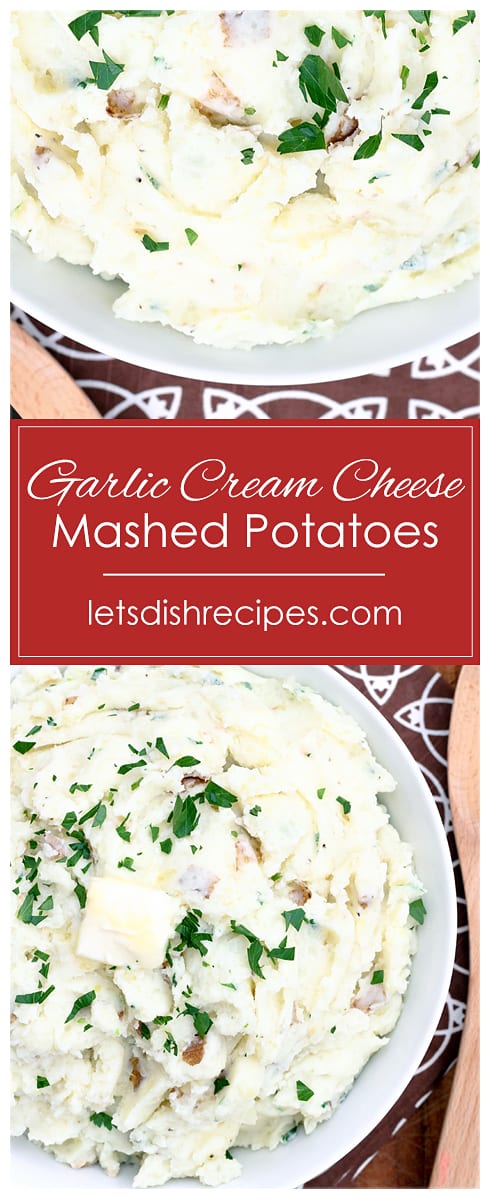
Creamy mashed potatoes loaded with minced garlic, butter, cream cheese and fresh parsley. The perfect side dish for holidays, Sunday dinner, or any night of the week!

Why You’ll Love This Recipe
I’m just going to lay it all on the line here and say these Garlic Cream Cheese Mashed Potatoes are the best mashed potatoes I’ve ever had!
Trust me, these have to be good, because a few of my boys are real mashed potato connoisseurs. But what’s not to love about fluffy mashed potatoes with butter, garlic, cream cheese and fresh parsley?
It’s definitely not a low-fat, low-calorie side dish, which makes these mashed potatoes a perfect holiday indulgence.
I like to leave some of the skins on–as many as my kids will tolerate–because I think it makes for a great presentation. And of course, the skins are good for you.
Sometimes I end up adding a bit of milk or cream to get the potatoes to the consistency I want, and sometimes I don’t need to add any at all. If you feel like you need to add a bit of liquid, just start slowly and add your liquid gradually.
I hope you love these mashed potatoes as much as my family does. Don’t forget the gravy!
Be sure to save this recipe to your favorite Pinterest board for later.
Ingredients
- Produce: potatoes, garlic, fresh parsley
- Butter
- Cream cheese
- Milk or cream
- Salt and pepper
Garlic Cream Cheese Mashed Potatoes
Ingredients
- 10 medium Russet potatoes peeled and coarsely chopped
- 1/4 cup unsalted butter diced
- 8 ounces cream cheese softened and cubed
- 3 cloves garlic minced
- Milk or cream as needed
- 1/4 cup chopped fresh parsley
- Salt and pepper to taste
Instructions
- Bring a large pot of salted water to a boil. Add chopped potatoes and cook until fork tender, about 15 minutes.
- Drain the potatoes and place them in a large bowl. Add the butter, cream cheese and garlic.
- Mash the potatoes with a potato masher until they reach the desired consistency and texture, adding milk or cream, as needed. Stir in the parsley and season with salt and pepper, to taste.
Nutrition
If you love this recipe, you might also like:
[mv_create key=”1287″ layout=”circles” title=”More Delicious Potato Recipes” type=”list”]




129 comments
Jasa Pembuatan Karil Manajemen
What makes a lot of Open University students search for aid regarding their
Karil?
Initially, when I encountered the word “Karil” at UT, I believed it was
simply an ordinary final project. But once I started the process,
I found out… it was actually trickier than preparing a fieldwork report.
From collecting references, outlining a framework, all the way to matching the Turnitin standards.
I previously tried writing it without help, and the result?
One week only got me half a chapter finished, and even that was still chaotic.
What Makes Karil Feel Like a Nightmare?
For Open University students, the primary issues are twofold:
– Not enough time. Because the majority of UT students are also working (Siregar, 2021).
– Scholarly skills. Not everyone is used to doing APA citations
or processing research data.
These two factors push many students to look for some support.
Some ask for help from friends, others end up turning to professional services.
Names like LapakJoki.com, TugasTuntas.com, and Karil.TugasTuntas.com frequently
come up when browsing for Karil solutions.
What’s the Difference Between Doing Karil Yourself and Using a Service?
I once be stubborn, thinking: “Ah, I can handle it on my own.” But eventually I realized
the heavy part wasn’t about being incapable, but about
the lack of structured direction.
That’s where Karil services become relevant.
They usually offer:
– A Karil outline according to UT standards.
– An initial draft to work with.
– Guidance for fixing citations so they comply with Turnitin.
According to research from Universitas Indonesia, students with extra academic tutors can finish final projects more consistently (Hidayat, 2022).
So it’s really similar to joining UTBK prep classes, only
this one is specifically for Karil.
Can These Services Be Considered a Shortcut?
This is a question that frequently pops up.
The answer: not really.
Because if you just receive the finished result without
understanding the content, be ready to get stuck when your professor
asks. What I personally found is that services like
TugasTuntas.com act more like partners. They deliver
the draft, but I still had to grasp and improve it myself.
According to UGM, an example-based learning approach can sharpen students’
academic skills (Prasetyo, 2021). So actually, by having a draft,
I learned how to create a more structured Karil.
Does Every Student Need These Services?
Honestly, not everyone. If you are a full-time student, have plenty of free time, and love
academic writing, you might be able to handle it alone.
But if you are:
– Busy working.
– Writing a scientific paper for the first time.
– Afraid of Turnitin plagiarism detection.
Then realistically, using a service like Karil.TugasTuntas.com makes a lot of sense.
Personal Experience: From Panic to Peace
I once went through multiple rounds of revisions from my supervisor.
It felt like every chapter was marked in red. Until I tried
using the service from LapakJoki.com.
The difference was clear. I got a structured draft, valid references, plus revision support.
As a result, I could focus more on presenting the content instead
of stressing over the format.
And surprisingly, it helped me better understand academic
structure. So if asked whether it’s worth it, for me personally:
absolutely worth it.
So, Worth It or Just a Waste of Money?
If you’re only looking for a “shortcut,” it might
look expensive. But if you consider time efficiency, reduced stress, and the chance to graduate on time, these
services become an investment.
It’s just like students joining prep courses for SNBT.
It’s not because they can’t study alone, but because they realize time is limited and a faster strategy is needed.
Conclusion: Don’t Wait Until You’re Stuck to Seek Help
I often see friends start searching for Karil services only when they’re already cornered.
But it’s actually better to start early. That way, there’s still time for revisions, discussions,
and developing a more mature Karil.
If you’re currently in this phase, maybe it’s time to explore your options.
And if I may recommend, check services with solid reputations like
TugasTuntas.com, LapakJoki.com, or Karil.TugasTuntas.com.
Because in the end, our target is the same: defending your thesis calmly
and graduating without unnecessary drama.
Mengatasi Plagiarisme
Is it possible that Turnitin tools and AI systems catch copied content?
Here’s a Complete Explanation + Safe Solutions for You
Plagiarism is now one of the most sensitive issues in the education world, especially
after the development of Turnitin systems and AI-based detection.
If you are a college student, working on a thesis, or creating scientific writing, you are probably aware of that anxiety: “Is this writing safe?”
In this article, we will break down comprehensively about plagiarism detection via Turnitin and AI, their mechanisms, their level of accuracy, and
simple strategies to keep you free from issues.
Don’t worry, the explanation is written casually but still insightful.
What Is Plagiarism and Why Is It a Big Problem?
Plagiarism is the act of copying content from other sources without
acknowledging the source.
In the scholarly environment, this is considered a significant breach.
According to research from Stanford University in 2021,
about a majority of students have done some form of plagiarism
in various forms, whether planned or not (Park, 2021).
This shows that plagiarism isn’t always intentional, but also about limited knowledge.
The problem is, modern academic systems are becoming more rigorous.
Many institutions already use plagiarism and AI detection tools to
ensure authenticity.
If plagiarism is detected, the risks can be significant:
Immediate zero score
Full revision required
Formal penalties
Therefore, it is very important for you to learn the mechanism.
What Is Turnitin and How Does It Work?
Turnitin is a software used to detect text similarity against a massive database, including:
Scientific journals
Books
Websites
Student paper repositories
Turnitin does not actually decide plagiarism, but instead shows a
similarity index.
According to a 2020 study by the University of Leeds,
Turnitin uses text comparison systems capable of detecting
similarity at advanced phrase structures (Walker,
2020).
So, even if you replace synonyms, it can still get flagged.
Is Turnitin the Same as Plagiarism Detection?
The short answer is: no.
Turnitin only provides a similarity percentage. For example:
around 10% → usually acceptable
25% → moderate concern
Above 40% → often problematic
However, these numbers must be analyzed further.
High similarity can be caused by:
Direct quotations
reference list
Technical terms
According to a study by Harvard GSE (2022), Turnitin results must be interpreted carefully, not just based on raw scores (Johnson, 2022).
What Is AI Plagiarism and Why Is It a New Issue?
With rapid tech development, tools like ChatGPT, Jasper, and others have emerged.
From this, a new term appears: machine-generated content issues.
AI plagiarism does not necessarily mean duplicating
work, but includes:
Using AI without modification
Generating overly generic text
detected as AI-written
According to MIT research (2023), about roughly one-third of
AI writing can be detected by AI detection tools such
as AI detectors like GPTZero (Nguyen, 2023).
How Do AI Detection Tools Work?
AI detection tools typically analyze:
writing patterns
linguistic structure
Word variation
Perplexity (randomness level)
If a text appears unnaturally consistent, it is often considered artificial.
Research from the University of Oxford (2023) shows that human text is more irregular compared to machine writing (Brown, 2023).
Is AI Writing Always Detectable?
Not necessarily.
Many factors influence detection:
How much you edit the AI output
language style
word count
AI checker applied
However, if you use raw AI output, the risk is very likely.
How to Avoid Turnitin Plagiarism?
You can apply various strategies to avoid high similarity:
Proper paraphrasing
Don’t just replace synonyms. Restructure the sentences too.
Use diverse sources
Don’t rely on a single source. Mix information from various sources.
Add personal insights
Include your own opinion. This makes your writing more authentic.
Use proper citation
Follow proper referencing formats such as APA style.
According to findings from University of Melbourne, proper
citation can lower plagiarism significantly (Clark, 2021).
How to Avoid AI Plagiarism?
Different from Turnitin, here are some effective tips:
Edit AI-generated content manually
Make manual improvements.
Add personal experience or perspective
Insert real-life context.
Use more natural language
Avoid overly formal tone.
Avoid overly perfect structure
Allow slight imperfections.
The main point is: avoid machine-like patterns.
What Are the Risks of Using Unprofessional Services?
Many students are interested in budget solutions. However, the
risks include:
High plagiarism levels
Substandard work
Being detected by lecturers
Full rewrite required
According to a survey from the University of Sydney (2022), about almost half who used unprofessional services had to repeat their work (Wilson, 2022).
What Are Safe Solutions to Handle Plagiarism?
If you want a safer and more practical option, there are several trusted services
that can help you.
Tugastuntas.com
This platform is suitable for general academic assistance, including:
academic writing
proofreading
Paraphrasing
Advantages:
Worked on by professionals
Revision requests available
Customized to campus requirements
karil.tugastuntas.com
If you focus on scientific writing such as:
assignments
undergraduate thesis
research journals
This service is more specialized.
They usually understand:
research formatting
APA style
Turnitin standards
Lapakjoki.com
This platform is more adaptable for various academic tasks.
Suitable for students who:
Have tight deadlines
want instant support
prefer finished assignments
Why Is Choosing the Right Service Important?
Because the quality of writing determines:
Your grades
your image as a student
your completion status
According to research from the University of Toronto
(2020), writing quality has a direct correlation with student success (Lee, 2020).
Is Using These Services Safe?
Generally safe as long as you:
use them for learning
comprehend the writing
avoid direct submission
Use them as tools, not cheating methods.
How to Choose the Right Service?
Pay attention to:
User testimonials
clear process
Revision policy
Communication support
Don’t be tempted by cheap prices alone.
Conclusion: Should You Be Afraid of Turnitin and
AI?
No need to be afraid, but you must learn the system.
Turnitin and AI detection are not obstacles, but tools
to maintain integrity.
If you:
develop your own writing
use proper references
maintain originality
you’re in a safe zone.
If you need help, consider reliable platforms such as Tugastuntas.com, karil.tugastuntas.com, and Lapakjoki.com.
Most importantly, always make knowledge development your main goal.
References (APA Style)
Brown, T. (2023). AI vs Human Writing. Oxford University Press.
Clark, J. (2021). Academic Integrity Studies. Melbourne University.
Johnson, R. (2022). Turnitin Interpretation Guide.
Harvard GSE.
Lee, S. (2020). Writing Quality and Academic Performance.
University of Toronto.
Nguyen, A. (2023). AI Detection Systems. MIT Journal.
Park, C. (2021). Plagiarism Trends in Students. Stanford.
Walker, D. (2020). Educational Text Matching Systems.
Leeds University.
Wilson, M. (2022). Essay Service Risks Study. Sydney University.
https://tugastuntas.com/joki-karya-ilmiah-universitas-terbuka/
For What Reason Many Learners at UT Turn To Academic Writing Help?
When I Look Back my College Days at Indonesia Open University,
there was One Period I could Not Skip: the Scientific
Writing Stage. For those who Are Unaware, Karil (short for *Karya
Ilmiah*) is basically a Final Project that Is Compulsory To be completed by
UT Undergraduates before Being Able To Attend
Graduation.
At first, I Assumed it would be Easy. I mean, Penning is just
about Putting Sentences Together, right? But once I Struggled With Research
Guidelines, APA citation rules, and the looming Challenge of Similarity Software, I quickly Recognized: “Okay, this isn’t A Game.”
And apparently, I wasn’t the only one Thinking
Like That. A Lot of of my Student Mates Experienced the same thing.
That’s why, it’s Understandable that more and more of them Searched For
Different Paths — including help from LapakJoki Service,
TugasTuntas.com, and even Dedicated Pages like Karil.TugasTuntas.com.
The Reasons UT Karil Feels Overwhelming
The first Common Concern that Is Frequently Heard: why is UT Karil Such
a Struggle?
Here’s my Opinion from Personal Experience and Exchanges with Friends:
UT Learners are Often Employed
So imagine this: Office Hours, and only Booting the Computer
at night — usually Fatigued. According to Study from Open University, more than 60% of UT
students are Active Workers (Siregar, 2021). No wonder many Encounter Problems to balance time.
Intense Academic Guidelines
Karil isn’t just a “long report.” It has Bibliography Guidelines, research
methods, even margin formats — and if something’s wrong,
revisions await.
Plagiarism Feels Like a Monster
Almost every Karil is checked via Turnitin. If the similarity index is over 30%, Brace Yourself For revisions.
For those not used to paraphrasing, this becomes a real obstacle.
This combination of three things makes UT Karil feel like a “final boss” of
sorts.
Is Depending on Karil Assistance Secure?
This is the Most Common Query I often Notice.
And honestly, I Thought the Same too.
Many people Get Anxious that using a Karil service
means Handing Over Everything. But actually, the services I Tried weren’t always like
that.
For example, TugasTuntas Service. They don’t just give you a final result, but also an outline, draft versions, and even revision services.
That means students still stay involved.
According to Findings from University of Indonesia, students who get external academic guidance are Able to Complete Faster their final projects compared to those working
completely alone (Hidayat, 2022). So actually, Karil services are more like a Private Tutoring
than an “illegal shortcut.”
What’s the Best Way to Pick a Karil Service?
This is Very Important. Because, honestly, not all Karil services are Reliable.
Some only copy-paste, which is obviously dangerous.
Back then, I made a sort of Set of Questions for myself:
– Is the website credible? For example, LapakJoki Online
is already quite well known among students.
– Is it specialized for UT? Since Karil UT has specific formats and
rules, Karil Section of TugasTuntas was built exactly for UT students.
– Does it offer revision guarantees? Because honestly, almost no Karil is
accepted by supervisors without revisions.
If these three conditions were met, I usually felt more confident.
Is Karil Connected with Exams Such as SNBT?
At first glance, it seems unrelated. But let’s look at it this way.
My younger sibling once took SNBT. She was the type who panicked when studying alone.
So she joined a prep course — to have mentors and guidance.
It’s the same with UT students facing Karil. The difference: SNBT focuses on UTBK questions, while Karil focuses on scientific writing.
According to a report from Indonesia’s Education Research Dept,
external support can increase GPA stability (Rahmawati,
2020). So really, the mindset is the same: seek help
to make the academic journey smoother.
Are Karil Services Necessary for All?
The answer: no.
If you have lots of free time, love digging into journals, and are
already comfortable writing academic work, maybe you can manage on your own.
But if you:
– Are busy working.
– Are writing your first academic paper.
– Are confused about dealing with Turnitin.
Then services like LapakJoki Hub or TugasTuntas Platform can be realistic
choices.
How I Went From Rejected Draft to Smooth Defense
I still remember my first Karil draft being rejected completely by my supervisor.
The revisions list was so long, it felt like rewriting an entirely new essay.
I almost wanted to quit.
Until I tried using the Karil Service by TugasTuntas.
The difference was obvious: clear structure, valid
references, and revisions handled quickly. Even though I still had to revise again, the process was smoother.
According to UGM research, example-based learning significantly
improves student academic ability (Prasetyo, 2021). And I really felt that.
From the drafts they gave, I learned how to write citations, structure methodology chapters, and keep similarity scores low.
Finally, my Karil was completed, the defense went smoothly, and I graduated on time.
How to Face Karil Revisions?
Honestly, revisions are “daily food.” Even with services, rejection can still
happen. But the difference is, with revision guarantees, you don’t need
to start from zero.
For example, at TugasTuntas Portal, they clearly state revisions are included.
So if there’s supervisor feedback, you just send it back to them for
fixes.
For me, that was a real lifesaver. Because if I had to redo everything myself, I
might have dropped out halfway.
Karil Services: Expense or Investment?
Many say Karil services are expensive. But think about it:
what costs more, paying once for help, or paying tuition again because you didn’t graduate on time?
For me, it was an investment. Especially while working.
With these services, I could stay productive at the office without abandoning my studies.
Besides, it’s similar to SNBT prep courses. People pay high fees to get into their
dream PTN. Why not apply the same mindset to completing Karil?
Karil Services: Your Call
I won’t say every student must use Karil services.
But from my experience, help like this can be a game changer.
If you feel stuck, don’t wait until you completely crash before seeking options.
Explore what’s available. And if I may recommend: go for
the trusted names like LapakJoki Portal, TugasTuntas.com, or Karil.TugasTuntas Platform.
Because at the end of the day, we all want the same target:
graduating on time, defending smoothly, and walking at
graduation with a big smile.