


Classic Alfredo sauce is combined with linguine and baked to perfection in this crowd-pleasing recipe!

Why You’ll Love This Recipe
If you’re looking for a simple, easy dish that the whole family will love, look no further than this Easy Alfredo Bake. It’s ready in just over 30 minutes, and everyone at the table will be going back for seconds!
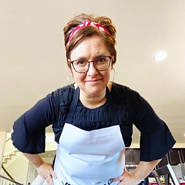
My 12 year-old gets all the credit for this recipe. Once a month or so I give my boys the chance to plan and help prepare dinner.
This simple pasta bake was his choice for the main dish. The original recipe he found on Pinterest included chicken, but he wanted to go with straight pasta, so that’s what we did.
Of course, you can probably imagine how the possibilities are endless for adding things like chicken, shrimp and vegetables to this dish. Or using different kinds of pasta.
We really love this recipe with linguine, but spaghetti and fettuccine are great too. Honestly, I can’t think of a pasta that wouldn’t pair well with Alfredo sauce.

I love that even with a homemade Alfredo sauce, this was such an easy meal to get on the table, and despite it’s plain and simple appearance, it was SO good!
I think it was the herbs de Provence, which I plan to add to all my Alfredo sauces from now on.
Because this dish is baked briefly at a very high temperature, you get lots of wonderful browning on the top. The crispy edges are my favorite part!
Just add a green salad or some steamed veggies and you’ve got a complete dinner that the will please even the pickiest of eaters.
Be sure to save this recipe to your favorite Pinterest board for later.

Ingredients
- Linguine
- Butter
- Flour
- Produce: garlic, fresh parsley
- Chicken broth
- Milk
- Mozzarella cheese
- Parmesan cheese
- Spices: herbs de Provence, nutmeg, salt and pepper
Easy Alfredo Bake
Ingredients
- 16 ounces linguine
- 1/4 cup butter
- 1/4 cup flour
- 1-2 cloves garlic minced
- 1 cup chicken broth
- 1 1/2 cups milk
- 2 cups mozzarella cheese divided
- 1/2 cup grated Parmesan cheese divided
- 1 teaspoon herbs de Provence
- 1/8 teaspoon ground nutmeg
- Salt and pepper to taste
- Chopped fresh parsley for garnish
Instructions
- Preheat the oven to 450 degrees. Lightly grease a large baking dish.
- Cook the linguine according to package directions. Drain and set aside.
- Meanwhile, in a large saute pan, melt the butter. Add the garlic and cook until fragrant, 1-2 minutes. Whisk in the flour until smooth.
- Gradually whisk in the chicken broth and milk, stirring until smooth. Cook and stir for about 5 minutes, or until sauce has thickened. Reduce heat and add half of the mozzarella and Parmesan cheeses. Season with herbs de Provence, nutmeg, salt and pepper, to taste.
- Combine the sauce with the cooked linguine and toss to coat well. Transfer the pasta to the prepared baking dish. Sprinkle with the remaining cheeses.
- Bake for 15-20 minutes or until bubbly and golden brown. Let stand 5-10 minutes before serving. Sprinkle with fresh parsley for garnish.
Nutrition
If you love this recipe, you might also like:
[mv_create key=”1252″ layout=”circles” title=”More Delicious Pasta Recipes” type=”list”]




137 comments
https://ngajarprivat.com/product/privat-utbk-snbt-di-malang/
Individual tutoring helps students prepare for PTN exams effectively.
What Are the Main Challenges for Prospective University
Students?
Navigating SNBP, SNBT, and independent admissions can be confusing for high schoolers.
Each university selection method has its own rules.
SNBP depends on school records; SNBT evaluates UTBK results.
University-specific exams make independent selection unique.
Knowing the characteristics of each PTN path helps students improve performance and pass rates.
How Private Tutors Help Accelerate Learning
From my friends’ experiences, private tutoring usually speeds up progress, especially for UTBK-based SNBT.
They help plan study routines, address tough problems, and show time-saving techniques.
Harvard Graduate School of Education research (Reich et al., 2020) shows
that one-on-one tutoring can increase comprehension by up to 30%
compared to self-study.
Beyond exercises, tutoring strengthens strategic thinking and time management skills.
Preparing for SNBP: Maximizing Academic Achievement
SNBP focuses on academic records rather than standardized tests.
Private tutoring helps maintain high grades over
multiple subjects.
They guide students on projects, portfolios, and
additional study.
Interaction with tutors enhances motivation and
performance (Mercer & Dörnyei, 2020).
Preparing for SNBT: UTBK Focus and Exam Strategies
SNBT preparation revolves around structured UTBK exercises.
Structured tutoring covers practice exams, answer elimination, and timing
techniques.
Intensive one-on-one guidance enhances exam results (Higgins et al., 2019).
Independent Selection: Major-Specific Strategies
Every university has its own rules for independent admissions.
Independent exams often test knowledge specific
to a student’s program.
Private tutors can adjust materials and exercises to match the characteristics of
each PTN exam.
Customized private lessons improve success rates in independent PTN selection by one-fourth.
Essential Subjects for University Entrance Exams
Mathematics: Fundamental for both Science and
Social Science tracks.
Physics, Chemistry, and Biology are key for aspiring Saintek majors.
Soshum preparation emphasizes Economics, Sociology, History,
and Geography.
Bahasa Indonesia and English: Important for all tracks.
Targeted private tutoring improves speed and comprehension in key subjects (Suryani & Prasetyo,
2021).
Tips to Maximize Private Tutoring
Targeted tutor selection ensures focus on critical exam
areas.
Choose tutors familiar with PTN exam patterns.
Daily practice with guidance improves mastery.
Hybrid tutoring balances flexibility and effective
learning.
Monitor learning outcomes and adjust plans.
Recommended Platforms for Private Tutoring
Platforms like NgajarPrivat.com provide experienced tutors for PTN applicants across majors.
KoncoSinau.id provides structured practice tailored to each selection type.
LapakGuruPrivat.com supports students with extra lessons
in key areas.
Conclusion: Why Private Tutoring Matters
From my friends’ experiences, private tutoring makes PTN preparation more structured and effective.
Students gain confidence, clear strategies, and readiness for each selection type.
The benefit of private tutoring includes better planning,
thinking, and test-taking skills.
These platforms simplify access to experienced PTN tutors.
PTN preparation is no longer daunting but can become an enjoyable
and effective learning process.
Bimbingan OSN
Can Previous OSN and OMI Questions Build Deeper Academic Understanding?
Previous olympiad questions can become valuable resources
for students who want to understand question patterns.
However, repeatedly remembering solution sequences may provide limited academic value when a
new problem presents a different context. The more productive approach
is to use previous questions as learning instruments that reveal
how concepts can be applied.
## Why Are Past OSN and OMI Questions Useful for Preparation?
Past questions can provide students with a clearer picture of how mathematical relationships may be transformed into competition problems.
A familiar textbook concept can appear in an unexpected scenario, requiring learners to transfer their understanding rather than reproduce a memorized response.
Reviewing previous questions therefore helps students recognize the practical
use of academic knowledge.
Another benefit is exposure to question diversity. Students may discover that similar
concepts can be tested through data interpretation. This exposure encourages strategic thinking instead
of dependence on one particular solution pattern.
> “The educational value of a past question lies
not only in its answer, but in the reasoning process required to reach that answer.”
Students can therefore treat past questions as learning
examples. The purpose is to understand the conceptual foundation behind
each problem. Once that foundation is understood,
learners can apply the same principles to questions that look completely
different.
## Why Is Understanding More Important Than Remembering Answers?
Memorization becomes problematic when students remember specific answers without
understanding the conditions under which those answers are
valid. A learner may correctly solve a question encountered previously
but struggle when one variable, assumption, or context is changed.
This indicates that answer recall has not necessarily developed into
conceptual mastery.
A useful test is to modify the original question after solving it.
Students can reverse a condition and then attempt the problem again.
If they can adapt the solution successfully, they are more likely to understand the conceptual relationship rather than merely recognizing the original question.
Students can ask themselves:
* Which principle is central to this problem?
* Why does this method work?
* Which variable could alter the result?
* Is there an alternative reasoning pathway?
* Can I teach the reasoning to someone else?
These questions transform answer checking into reflective learning.
They also help students identify whether their knowledge is genuinely transferable.
## How Should Learners Study the Reasoning Behind Previous Olympiad Problems?
Before examining the official solution, students can attempt to identify the primary academic idea independently.
They should then determine which information is essential
and which details function mainly as additional description. This encourages
learners to develop their own problem representation.
After completing the question, students can compare their
reasoning with the available solution. The objective is
not simply to determine whether the final answer is consistent, but to examine differences in approach.
A different method can sometimes be equally valid if it follows sound logical principles.
Students can record each question according
to several analytical components:
| Element | Question to Consider |
|—|—|
| Concept | Which concept forms the foundation? |
| Information | What information must be used? |
| Method | Which method fits the problem? |
| Reasoning | Why does one step lead to another? |
| Transfer | What changes if the conditions are modified? |
This type of structured analysis can make previous questions
significantly more useful. Instead of collecting hundreds of answers, students gradually build a conceptual reference system.
## Can Past Questions Be Modified for Deeper Olympiad Practice?
One effective technique is to modify previous
questions. Students can change the numerical
values, experimental conditions, variables,
or assumptions while preserving the underlying concept. This produces a new problem that requires transfer rather than simple recognition.
For example, a physics problem involving force can be modified by changing
one relevant condition. A biology problem can introduce
a modified genetic condition. Chemistry questions can be transformed by changing temperature, while mathematics problems can use different parameters.
This practice creates an important distinction between recognizing a problem.
If students can solve the modified version, they demonstrate that their knowledge
is not completely dependent on the original wording.
Reconstructing questions can therefore encourage deeper conceptual learning.
> “One well-understood question can generate several new learning opportunities when students examine how its assumptions and variables can be changed.”
## How Can Students Build a Personal Archive of Olympiad Questions?
Students do not need to maintain an enormous collection of random
questions. A smaller archive organized according to subject can be more useful for
systematic revision. This structure makes it easier to identify which concepts
repeatedly appear across different problems.
For each question, students can record the concept tested.
They can also assign a simple topic label so related problems can be
reviewed together. Over time, this archive becomes a personalized problem-solving library.
The archive can also distinguish between questions that remained difficult.
This distinction provides useful information about conceptual
development. When revisiting the material, learners can prioritize questions
that previously exposed knowledge gaps.
## Can Private Tutoring Make Past Question Analysis More Effective?
A private tutor can help students examine the strategic decisions behind previous olympiad questions.
Instead of immediately presenting the solution, a tutor can ask diagnostic questions that encourage the learner to explain why a particular method should be used.
This can reveal whether the student has understood the
principle.
Tutors can also introduce modified versions after a student completes a previous question. The learner must
then determine which parts of the original reasoning remain applicable
and which parts need to be changed. Such activities
encourage independent analysis.
For families seeking specialized OSN preparation, platforms such as KoncoSinau.id, LapakGuruPrivat.com, and NgajarPrivat.com can be considered.
Individual guidance can be especially useful when students
need help understanding why a solution works. The emphasis should remain on developing academic understanding,
rather than simply accumulating completed answers.
## What Is the Best Way to Review Old Competition Questions?
Students can use a three-stage approach: adapt. First, they
solve the original question without immediately
checking the answer. Second, they examine the concepts involved and compare their approach with the available explanation. Third,
they create a variation and attempt to solve it independently.
This process transforms one past question into a multi-stage learning exercise.
Students are no longer limited to asking whether they obtained the correct answer.
Instead, they examine why the solution is valid.
A practical review routine could include:
1. Attempt the original problem independently.
2. Describe the concept behind the solution.
3. Compare the reasoning with the official explanation.
4. Identify any conceptual or procedural mistakes.
5. Modify one or more conditions.
6. Reattempt the new version without relying on the original answer.
Repeated exposure to this process can strengthen independent
reasoning. It also makes practice material more purposeful.
## Using Past Questions as a Tool for Deeper OSN and OMI Preparation
Previous OSN and OMI questions can provide valuable exposure to advanced academic applications.
Their usefulness, however, depends largely on how students study them.
When learners focus exclusively on question repetition, the opportunity for
deeper conceptual development can be limited.
A more analytical approach encourages students to
examine reasoning strategies and then transfer those ideas into new contexts.
Modifying old questions, comparing solution methods,
and maintaining a structured problem archive can turn previous exercises into a personal academic reference.
This approach is particularly relevant for students preparing for
demanding science olympiad competitions.
Ultimately, the goal is not to recognize a question because
it looks familiar. The more meaningful objective is to understand the logical mechanism
deeply enough to approach a new problem from an informed starting point.
With reflective review, previous questions can become more than preparation materials; they can serve as tools for
developing academic problem-solving skills.
# Can Previous OSN and OMI Questions Build Deeper Academic Understanding?
Previous olympiad questions can become valuable resources for students who want to understand question patterns.
However, repeatedly copying familiar methods may provide
limited academic value when a new problem presents a different context.
The more productive approach is to use previous questions as learning instruments that reveal how concepts
can be applied.
## Why Are Past OSN and OMI Questions Useful for Preparation?
Past questions can provide students with a clearer picture
of how scientific principles may be transformed into
competition problems. A familiar textbook concept can appear in an different
representation, requiring learners to transfer their understanding
rather than reproduce a memorized response. Reviewing previous questions therefore helps students recognize the
connection between concepts and problems.
Another benefit is exposure to question diversity.
Students may discover that similar concepts can be tested
through experimental scenarios. This exposure encourages conceptual flexibility instead
of dependence on one particular solution pattern.
> “The educational value of a past question lies not only in its answer,
but in the reasoning process required to reach that answer.”
Students can therefore treat past questions as learning examples.
The purpose is to understand the reasoning mechanism behind each problem.
Once that foundation is understood, learners can apply the same principles to questions
that look completely different.
## How Can Students Avoid Memorizing Past Question Patterns?
Memorization becomes problematic when students remember
particular solution sequences without understanding the conditions under which those answers are valid.
A learner may correctly solve a question encountered previously but struggle when one variable, assumption, or context
is changed. This indicates that surface familiarity has not necessarily developed
into transferable understanding.
A useful test is to modify the original question after
solving it. Students can alter the scenario and then attempt the problem again. If they can adapt the solution successfully, they are more likely to understand the conceptual relationship rather than merely
recognizing the original question.
Students can ask themselves:
* Which principle is central to this problem?
* What makes the solution logically valid?
* What would change the answer?
* Is there an alternative reasoning pathway?
* Can I teach the reasoning to someone else?
These questions transform routine repetition into conceptual investigation. They also help students identify whether their knowledge is
procedural.
## What Should Students Look For in Past Questions?
Before examining the official solution, students can attempt
to identify the central principle independently. They should then determine which information is necessary and which details function mainly as
context. This encourages learners to develop their
own reasoning pathway.
After completing the question, students can compare their reasoning with the available solution. The
objective is not simply to determine whether the final answer is consistent, but to examine differences in approach.
A different method can sometimes be equally valid if
it follows sound logical principles.
Students can record each question according to several analytical components:
| Component | Question to Consider |
|—|—|
| Principle | Which concept forms the foundation?
|
| Information | What information must be used?
|
| Method | Which method fits the problem? |
| Logic | How are the steps connected? |
| Adaptation | What changes if the conditions are modified?
|
This type of systematic review can make previous questions significantly
more useful. Instead of collecting hundreds of answers, students gradually
build a personal knowledge framework.
## Can Past Questions Be Modified for Deeper Olympiad
Practice?
One effective technique is to reconstruct previous questions.
Students can change the numerical values, experimental conditions, variables,
or assumptions while preserving the underlying concept.
This produces a new problem that requires adaptation rather than simple recognition.
For example, a physics problem involving energy can be modified by changing one relevant condition. A biology problem can introduce a new environmental factor.
Chemistry questions can be transformed by changing concentration, while mathematics problems can use different functional relationships.
This practice creates an important distinction between recognizing a problem.
If students can solve the modified version, they demonstrate that their knowledge is not completely dependent on the original wording.
Reconstructing questions can therefore encourage adaptive problem solving.
> “The ability to modify a problem demonstrates that students are beginning
to understand the structure beneath the original question.”
## How Can Students Build a Personal Archive of Olympiad Questions?
Students do not need to maintain an enormous collection of random questions.
A smaller archive organized according to concept can be more useful for systematic
revision. This structure makes it easier to identify which concepts repeatedly appear across different
problems.
For each question, students can record the concept tested. They can also assign a simple
subject classification so related problems
can be reviewed together. Over time, this archive becomes a personalized learning
database.
The archive can also distinguish between questions requiring assistance.
This distinction provides useful information about conceptual development.
When revisiting the material, learners can prioritize questions that previously exposed reasoning difficulties.
## What Role Can Tutoring Play in Reviewing Past Questions?
A private tutor can help students examine the strategic decisions behind previous olympiad questions.
Instead of immediately presenting the solution, a tutor can ask Socratic-style
prompts that encourage the learner to explain why a particular method should be used.
This can reveal whether the student has developed transferable reasoning.
Tutors can also introduce parallel problems after a student completes a
previous question. The learner must then determine which
parts of the original reasoning remain applicable and
which parts need to be changed. Such activities encourage adaptability.
For families seeking specialized OSN preparation, platforms such as KoncoSinau.id, LapakGuruPrivat.com, and NgajarPrivat.com can be considered.
Individual guidance can be especially useful when students need help understanding why a solution works.
The emphasis should remain on developing independent reasoning, rather than simply accumulating completed answers.
## What Is the Best Way to Review Old Competition Questions?
Students can use a three-stage approach: attempt.
First, they solve the original question without immediately checking the answer.
Second, they examine the assumptions involved and compare their approach with the available explanation. Third, they create a new application and attempt
to solve it independently.
This process transforms one past question into a multi-stage learning exercise.
Students are no longer limited to asking whether they obtained the
correct answer. Instead, they examine how the problem works.
A practical review routine could include:
1. Solve the original problem independently.
2. Describe the concept behind the solution.
3. Compare the reasoning with the official explanation.
4. Identify any conceptual or procedural mistakes.
5. Adapt one or more conditions.
6. Reattempt the new version without relying on the original answer.
Repeated exposure to this process can strengthen analytical flexibility.
It also makes practice material more academically meaningful.
## Developing Transferable Knowledge Through Past Competition Questions
Previous OSN and OMI questions can provide valuable exposure to unfamiliar problem structures.
Their usefulness, however, depends largely on how students study them.
When learners focus exclusively on question repetition, the
opportunity for deeper conceptual development can be
limited.
A more analytical approach encourages students to examine
reasoning strategies and then transfer those ideas into new contexts.
Modifying old questions, comparing solution methods, and maintaining a
structured problem archive can turn previous exercises
into a long-term learning resource. This approach is particularly relevant for students preparing for
demanding OSN competitions.
Ultimately, the goal is not to recognize a question because it looks familiar.
The more meaningful objective is to understand the conceptual structure deeply
enough to approach a new problem from an informed starting point.
With reflective review, previous questions can become more
than preparation materials; they can serve as tools for developing academic problem-solving skills.
https://karil.tugastuntas.com/product/joki-karil-ut/
How Can Students Make Their Karil UT More Scholarly and Rigorous?
Writing a Karil UT requires more than collecting references into a single document.
Students are expected to present their ideas through a logical academic structure supported by relevant evidence.
For many UT students, the main challenge is not finding information, but transforming that information into an academically credible argument.
Academic quality is also not determined exclusively by the number of
pages. A relatively concise article can be academically stronger than a longer paper
when its arguments are methodologically sound. Therefore, students
should pay attention to the relationship between research questions, theoretical perspectives,
methodology, findings, and conclusions.
> Academic quality comes from the coherence of the argument, not merely from
the volume of information presented.
## Which Elements Determine the Quality of a Scientific Article?
A high-quality Karil UT should demonstrate a clear research focus.
The reader should be able to identify the research problem, understand why it matters,
and follow the reasoning that connects the problem to the research objectives.
When these elements are aligned, the manuscript becomes more academically structured.
Academic quality also depends on how students use evidence.
A statement presented as an academic argument should ideally
have an appropriate theoretical or empirical basis rather than relying solely on personal opinion. This does not mean every sentence requires
a citation, but significant claims should be supported by
appropriate sources.
## Make the Research Problem More Academically Focused
A common weakness in student research is a research problem that
remains too broad. When the research problem is vague, subsequent sections may also become difficult to control.
Students should therefore identify the research gap
that the article intends to investigate.
A well-defined problem can guide the formulation of research questions.
For example, rather than discussing an extensive social or
educational issue, students can narrow the discussion to a particular population, variable, location, or period.
Such delimitation makes the research more methodologically
feasible.
### Keep the Introduction Focused on the Research Issue
The introduction should provide sufficient context without becoming an extended discussion of everything related
to the topic. Students sometimes include numerous general
definitions before eventually introducing the actual research problem.
This approach can make the article appear lengthy while leaving the central issue
insufficiently developed.
A more effective strategy is to move gradually from
the general context toward the specific problem being investigated.
Each paragraph should contribute to the explanation of why
the research is relevant. By maintaining this
progression, the introduction becomes more purposeful.
## Strengthen Arguments with Appropriate Academic Sources
The quality of references can significantly influence the academic credibility of a
Karil UT. Students should prioritize sources that are credible and directly connected to their
research topic. A long bibliography does not necessarily
demonstrate strong scholarship if many sources have little relationship with the actual argument.
When selecting references, consider whether the source
provides theoretical support. A theoretical article
may be appropriate for defining a concept, while an empirical
study may be more useful when comparing research findings.
This distinction helps students use references for a specific academic
purpose.
> The relevance of a source is often more important than the
sheer number of sources cited.
## Improve the Link Between Theory and Research Findings
One important indicator of academic quality is the relationship between the literature review and the research findings.
Students should avoid presenting theories in one section and empirical findings in another without explaining how the two relate.
The discussion should demonstrate whether the findings contradict
previous theoretical or empirical perspectives.
For instance, if the findings indicate a particular relationship between two variables,
students can compare that result with previous studies. Similarities may strengthen an existing explanation, while differences may indicate contextual factors that deserve
further discussion. Such comparison transforms the discussion from a simple description of results into a more analytical academic
argument.
## Turn Results into Academic Interpretation
A discussion section should not simply repeat the numbers or statements already presented in the results section.
Instead, students should explain the implication of the findings in relation to the research question. This requires moving from “what was found” toward
“what the finding may indicate.”
Students can strengthen this section by considering
several dimensions, including comparison with previous research.
However, interpretations should remain consistent with the available evidence.
Avoid making claims that extend far beyond the scope of the data simply because they appear more impressive.
## Use Precise Academic Language
Academic writing does not require unnecessarily
complicated vocabulary. In fact, excessive use of elaborate phrasing can make
an argument more difficult to understand. Students should
prioritize precise terminology and sentence structures that communicate the intended
meaning without unnecessary complexity.
It is also useful to avoid unsupported generalizations.
Phrases such as “everyone knows” or “it is obviously true” rarely strengthen an academic argument unless supported by appropriate evidence.
More precise language allows students to communicate
their claims with greater conceptual accuracy.
## Review the Logical Flow Before Submission
After completing the manuscript, students should conduct a final academic audit.
Do not focus exclusively on grammar or formatting because structural inconsistencies
can be more consequential. Check whether the title, research questions, objectives,
methodology, findings, discussion, and conclusion remain conceptually aligned.
One useful approach is to read the manuscript as if
you were an external reviewer. Ask whether the research question is actually answered by the findings and
whether the conclusion is supported by the evidence presented.
This process can reveal logical gaps that may not be obvious during the initial writing stage.
## How Can Students Get Academic Support for Their Karil?
Students who find it difficult to evaluate the academic quality of
their own manuscript may benefit from an additional review.
**TugasTuntas.com** can be considered for support related to academic writing, research methodology, argument development, citation organization, and manuscript review.
Such assistance can be particularly useful when students need another perspective on whether the sections of their article are sufficiently
coherent.
For broader academic support, **LapakJoki.com** can also provide assistance with writing guidance.
Meanwhile, students specifically working on Karil UT can explore **Karil.TugasTuntas.com** for more focused support related to the structure and development of
their scientific article. Students should nevertheless review the final manuscript themselves and ensure that
all academic assistance remains consistent with the applicable institutional requirements.
## Academic Quality Checklist for a Karil UT
Before submission, students can conduct a final quality-control process.
Confirm that the research problem is specific,
the objectives are aligned, the methodology is appropriate,
and the findings directly address the research questions.
Also examine whether the discussion provides
sufficient interpretation rather than merely repeating descriptive information.
A practical checklist may include the following questions:
Is the argument consistent throughout the manuscript?
Are the references relevant to the claims being made?
Does the conclusion accurately reflect the evidence without introducing new arguments?
Are terminology, variables, citations, tables, and methodological descriptions accurate?
Ultimately, improving the academic quality of a Karil UT
is a process of refinement, rather than simply adding more pages or
references. Students should focus on strengthening the relationship between the research problem,
theoretical foundation, methodology, evidence,
interpretation, and conclusion. When these components work together coherently, the manuscript becomes more
readable.
A strong Karil UT should therefore communicate not only what results were obtained, but also
why those findings matter within the context of the research.
By reviewing the manuscript critically and revising weak connections
between its sections, students can produce a more coherent and
academically grounded article. Careful revision, appropriate evidence, and methodological consistency are ultimately more valuable than simply
making the manuscript more heavily referenced.